Welcome to the fast lane.

In today's rapidly changing business world, constant innovation is essential.
While many companies struggle with this challenge, others achieve continuous success through proactive adjustments.
These frontrunners have one thing in common: they understand innovation correctly and pursue a holistic approach to efficiently ensure sustainable results.
You don't have to be a technology company, nor do you need a huge budget and a lot of time.
On the contrary, with the right understanding and approach, you can save time and money, boost employee motivation and productivity and automatically keep your finger on the pulse.
Getting innovation right.

The dilemma of innovation often begins with a misinterpretation of the term itself.
Innovation in itself has nothing to do with an invention that has to be fundamentally new.
On the other hand, an invention does not automatically become an innovation, as it must first pass through the 4 pillars of innovation. Otherwise it remains merely an invention.
In short, an innovation does not have to be a world first, but merely a new approach for you that is successfully implemented, offers added value and is accepted.
Innovation vs. Invention.

The best-known innovations were not new inventions.
The first iPhone, which came onto the market in 2007, was not the first smartphone. Back in 1994, IBM introduced the “IBM Simon Personal Communicator”, which had a touchscreen and offered the option of sending emails and faxes. However, this device met with little acceptance, which is why it never became an innovation.
Another example is the light bulb, a symbol of innovation, which was also based on older ideas. Ebenezer Kinnersley” produced prototypes as early as 1791. However, it was Thomas Alva Edison's light bulb, which was launched on the market in 1880, that became established and became an innovation.
Even Henry Ford revolutionized the automotive industry (Fordism) with an “old” concept derived from meat processing industry.
The 4 Pillars of Innovation.
Only if these 4 pillars can be ticked off is it a real innovation.
However, “innovative” does not have to be a world first, but something new for you, your company or your customers.
Furthermore, this new approach must be successfully implemented, generate added value and meet with relevant acceptance.
Novel.
Value.
Realization.
Acceptance.

These 4 different pillars also show well how multidimensional innovation is. It is therefore not just about creative ideas, but also about empathy, marketing, effective and efficient implementation, etc. It is therefore inevitable that innovation is tackled across departments or by mixed teams from the outset. Anyone who thinks that innovation is just an R n' D or pure IT matter will fail for better or worse.
Innovation im 3er Pack.
In order to remain sustainably innovative as a company, it is essential to know the three types of innovation and to combine them in a targeted manner.
Efficiency-enhancing innovation focuses on optimizing the existing core business. Sustaining innovation promotes growth by innovating the existing business model. Transformative innovation, on the other hand, opens up completely new business models based on the knowledge and resources gained from previous activities.
Through its original business model, Amazon collected important data, developed the necessary AI to improve processes and created large storage capacities, which ultimately formed the basis for Amazon Web Services.
Efficiency
Innovation.
Core Business
ROI in Horizon 1
Bsp. Amazon Online Bookstore
Sustaining
Innovation.
Growth Business
ROI in Horizon 2
Bsp. Amazon Marketplace
Transformative
Innovation.
Future Business
ROI in Horizon 3
Bsp. Amazon Web Services
Crack the code for unparalleled success.
Innovation in companies is not a straightforward process, as is often assumed, but a multi-layered, interactive system.
An in-depth understanding of innovation that takes all influencing factors into account enables you to create a harmonious synergy that leads you to continuous success.
Companies are divided into four interconnected ecosystems that interact and influence each other. ImpactOvation therefore pursues a comprehensive approach to innovation that produces effective results with long-term impact.
Customer Solutions.
Offering Level.
Produkte, Dienstleistungen, Plattformen etc.
Brand.
Angebotsebene.
Corporate Identity/Design, Marketing...
Business Model.
Business Model Canvas
Kundensegmente, Value Proposition, Vertriebs-und Kommunikationskanäle, Kundenbeziehungen, Einnahmequellen, Ressourcen, Aktivitäten, Partner, Kosten.
Operations.
Support Level.
Processes, cooperation, development, procurement, service providers...
Finanzen.
Support Level.
Ertrag, Eigenkapital, Kostenoptimierung, Investitionen ...
Technology.
Base.
IT-Architektur, Schnittstellen, Daten, Technologien, Business Applikationen...
Organization.
Base.
Kompetenzen, Leadership Stil, Struktur, Kultur, Kompensation, Stellenbeschriebe, Teamwork...
Develop a comprehensive understanding of innovation in order to solve your challenges at the root instead of just scratching the surface. This will successfully differentiate you from the competition and save you time, money and nerves at the same time. We will be happy to assist you.
Wie Business Model Innovation den Unterschied macht.
In einer Welt voller Wandel gewinnen nicht die Stärksten, sondern die Anpassungsfähigsten. Business Model Innovation bedeutet, bestehende Spielregeln zu hinterfragen – und neue aufzustellen. Es geht darum, Wertschöpfung ganzheitlich neu zu denken.
Das "Magische Dreieck" bietet dafür einen klaren Rahmen. Es beleuchtet die vier zentralen Dimensionen eines Geschäftsmodells – Wer, Was, Wie und Wieviel. Dabei gilt: Erst wenn mindestens zwei dieser Elemente grundlegend verändert werden, spricht man von Geschäftsmodell-Innovation. Alles andere bleibt Optimierung im bestehenden System.
W
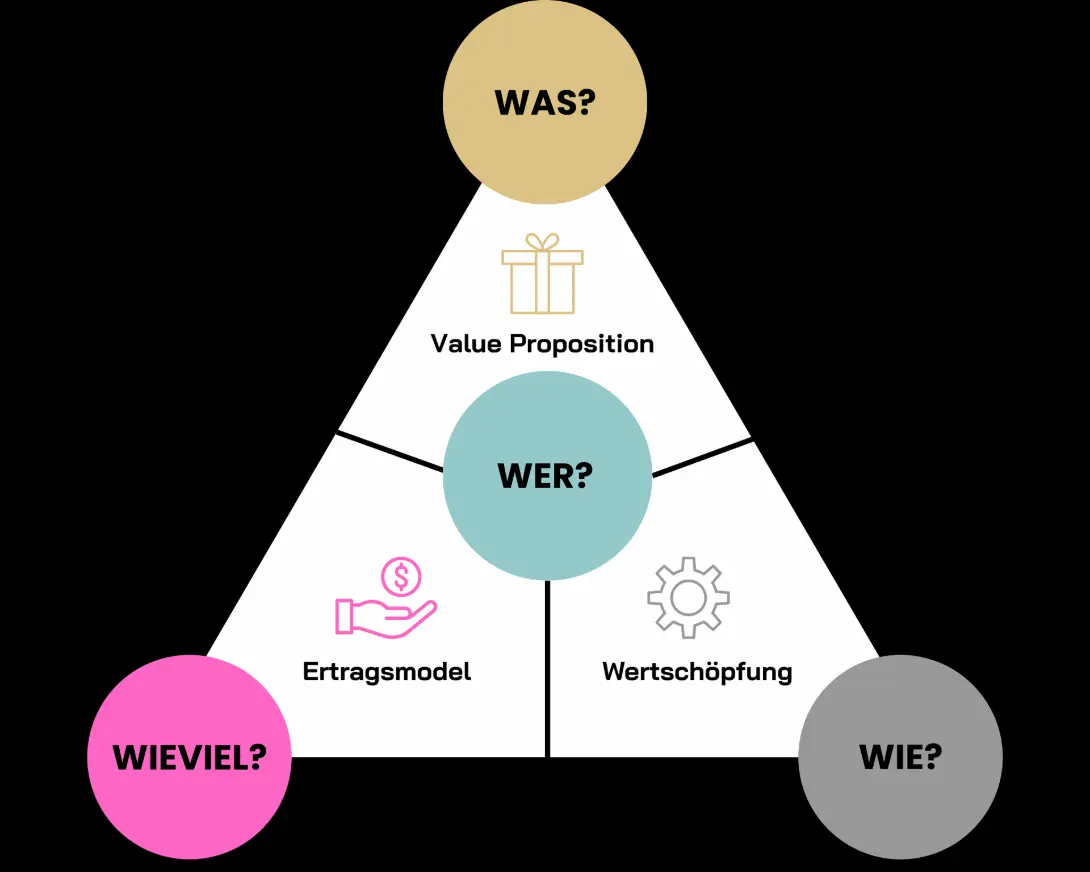
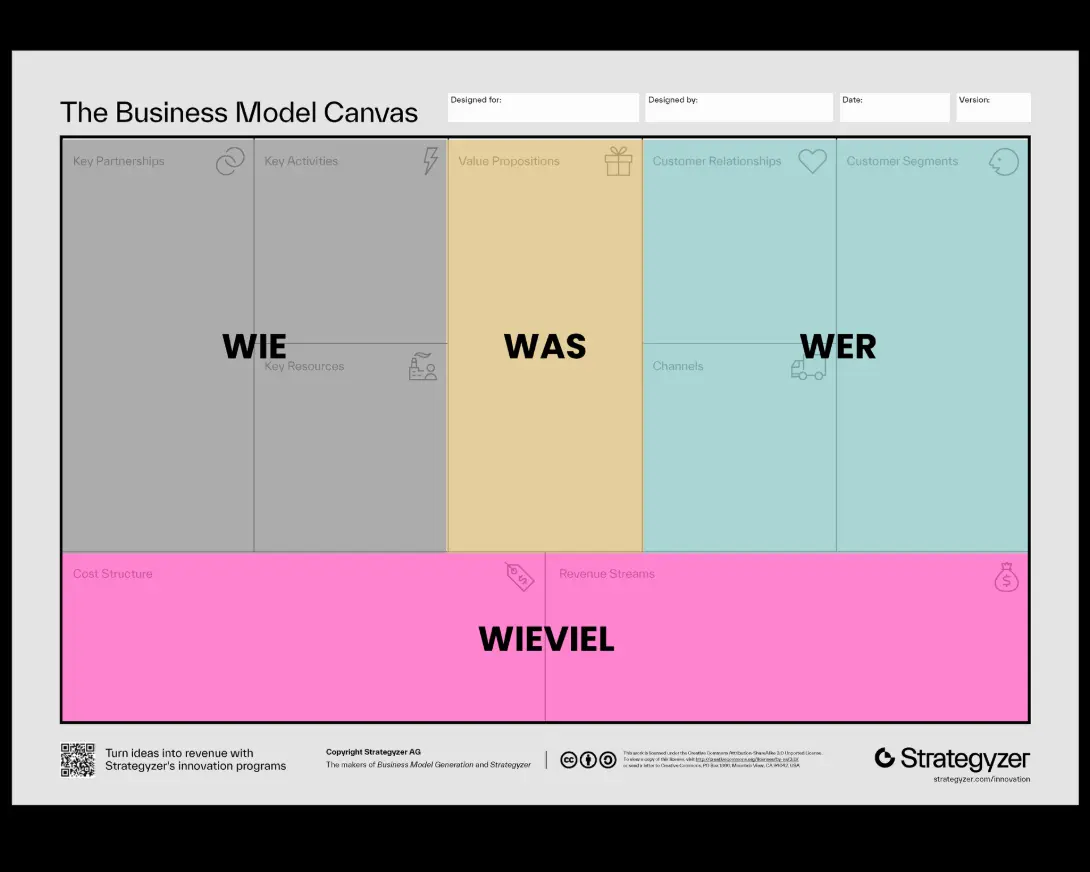
Ein greifbares Beispiel ist auch hier wieder Amazon. Seit Bestehen haben sie mehrfach gleich mehrere Elemente des Geschäftsmodells neu kombiniert: neue Zielgruppen, neue Ertragsmodelle, neue Wertschöpfungslogik. Heute ist das Unternehmen eine globale Plattform mit Innovationskraft weit über den Handel hinaus – getrieben durch konsequente Geschäftsmodell-Innovation.
Ob Start-up oder etabliertes Unternehmen: Wer sein Geschäftsmodell mutig weiterdenkt, schafft Raum für Wachstum, Differenzierung und echten Impact. Die beste Zeit dafür? Jetzt.